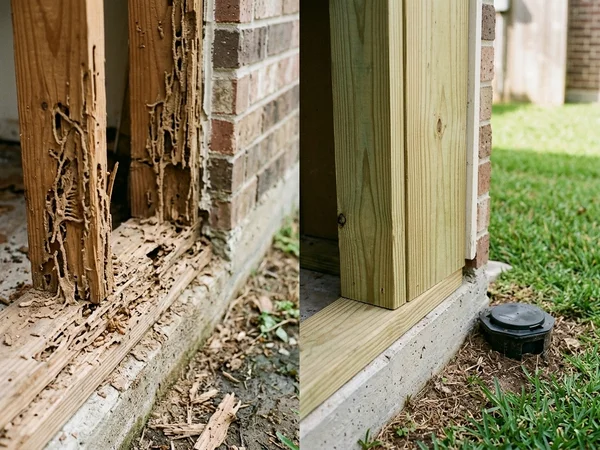
“We had subterranean termite mud tubes running up a rear pier on our foundation — right along a live oak root. David understood immediately that the root corridor was the entry vector and applied treatment there specifically, not just around the general perimeter. That targeted approach made the difference.”
Subterranean Termite Treatment — Tanglewood
Subterranean Termite Treatment in Tanglewood, TX
Harris County's clay soil never fully dries — which means subterranean and Formosan termite colonies beneath Tanglewood's established lots stay active year-round. Resolve delivers full-perimeter liquid barrier and Sentricon programs that interrupt foraging routes and eliminate colonies at the source.
- Full-perimeter liquid termiticide barriers in clay soil conditions
- Sentricon Always Active bait stations targeting Formosan colonies through oak root corridors
- Year-round subterranean termite pressure addressed — not just swarm season
Why Tanglewood's Subterranean Termite Pressure Demands Specialized Treatment
Clay soil, mature root networks, and drip irrigation create year-round subterranean and Formosan termite conditions unique to Tanglewood.
- Harris County clay soil retains moisture year-round, sustaining large subterranean termite populations beneath every lot
- Formosan termites use Tanglewood's mature live oak root networks as underground foraging highways to foundations
- Drip irrigation near foundations elevates soil moisture — the primary attractor for subterranean termite foragers
- Full-perimeter liquid barriers create continuous soil protection that does not depend on termites finding bait
- Sentricon bait stations eliminate colonies at the queen level — stopping reproduction, not just foragers
- Annual monitoring tracks treatment integrity through each successive Tanglewood swarm season
Tanglewood Homeowners on Resolve's Subterranean Termite Treatment
Clay Soil Specialists Formosan Control Annual Monitoring
“After a Formosan termite swarm in our backyard in May, I called Resolve. David inspected the soil near our oaks and confirmed an active colony. The Sentricon program he installed eliminated the colony in about 60 days. He checks the stations every spring and I haven't had another swarm since.”
“I had a liquid barrier treatment done two years ago by a national company that didn't hold. David assessed the previous treatment, identified where the barrier had broken down in the clay soil near the irrigation line, and re-treated the compromised zone specifically. Problem solved.”
Subterranean Termite Treatment Methods for Tanglewood Properties
Resolve combines the two most effective tools in subterranean termite control — liquid barriers and Sentricon bait — for Tanglewood's demanding soil and canopy conditions.
Full-Perimeter Liquid Barrier Treatment
Termiticide is injected into the soil at regular intervals around the full foundation perimeter, creating a continuous chemical zone that kills subterranean and Formosan termites on contact as they forage toward the structure.
Root Corridor Targeted Treatment
David identifies where Tanglewood's oak root systems run closest to foundations and concentrates treatment in those soil zones — addressing the primary Formosan foraging routes that generic perimeter programs often miss.
Sentricon Always Active Bait Stations
Bait stations placed at intervals around the property attract foraging workers, who transport the active ingredient back to the colony. Over 30-90 days, the entire colony — including the queen — is eliminated.
Drip Irrigation Zone Treatment
Moisture accumulated near foundation drip lines is a primary subterranean termite attractor. David addresses these moisture zones during treatment, closing the gap between irrigation infrastructure and termite entry points.
Annual Barrier Re-Inspection
Liquid barriers in Tanglewood's clay soil need periodic assessment — heavy rainfall and root growth can create gaps over time. Annual inspection keeps barriers continuous and effective through each successive termite season.
Pre-Construction Soil Treatment
For Tanglewood teardown-rebuild projects, pre-construction soil treatment protects new foundations before structural wood is introduced — preventing colony establishment in disturbed soil where subterranean pressure is highest.
How Subterranean Termite Treatment Works in Tanglewood
A targeted, systematic process that accounts for Tanglewood's clay soil, oak canopy, and foundation irrigation conditions.
- 1
David inspects foundation perimeters, soil conditions near root systems, crawlspaces, and irrigation zones to map where subterranean termites are entering or likely to enter. Active mud tubes, moisture zones, and conducive conditions are documented.
- 2
Based on the inspection, David recommends a liquid barrier treatment, a Sentricon bait program, or a combined approach. Active infestations with confirmed root corridor access typically warrant both methods working together.
- 3
Termiticide is injected into foundation soil at label-required intervals, with targeted concentration at root corridor zones. Sentricon bait stations are installed at foraging-route intercept positions across the lot.
- 4
David returns each spring before Tanglewood's Formosan swarm season, inspects bait stations, assesses liquid barrier integrity, and identifies any new foraging pressure before it reaches structural wood. No contract required.
Resolve vs. Generic Subterranean Termite Programs in Tanglewood
Tanglewood's clay soil and Formosan pressure require treatment protocols that go beyond a standard perimeter application.
| Feature | Resolve Pest and Termite | Generic Termite Programs |
|---|---|---|
| Root corridor entry points specifically targeted | ✓ | ✗ |
| Irrigation zone moisture assessment included | ✓ | ✗ |
| Formosan-specific bait station protocols | ✓ | ✗ |
| Combined liquid and bait approach available | ✓ | Liquid only |
| Annual barrier integrity assessment | Always included | Add-on fee |
| No long-term contract required | ✓ | ✗ |
| Owner performs every treatment | ✓ | ✗ |
Case Study
How Resolve Stopped Year-Round Subterranean Termite Foraging at a Tanglewood Foundation
The Problem
A Tanglewood homeowner on a heavily landscaped lot with drip irrigation throughout the garden beds noticed mud tube construction on a rear foundation pier during the winter — not swarm season, which indicated a large, well-established subterranean colony foraging continuously despite cold weather. The lot had three large live oaks whose roots ran within six feet of the rear slab edge.
Our Solution
David applied full-perimeter liquid barrier treatment with concentrated injection along the rear foundation adjacent to the oak root zone. Three additional injection points were placed at the confirmed mud tube entry site. Eight Sentricon bait stations were installed along the rear property line in positions that intercepted foraging routes between the root systems and the foundation.
The Outcome
A three-month follow-up inspection showed no active mud tube construction and confirmed bait station activity indicating the colony was in decline. A six-month inspection confirmed elimination. The homeowner enrolled in annual spring monitoring and had the irrigation drip emitters near the foundation adjusted to reduce sustained moisture against the slab.
Subterranean Termite Treatment FAQs for Tanglewood Homeowners
Why do subterranean termites stay active year-round in Tanglewood?
Harris County's clay soil retains heat and moisture even in winter, preventing the soil temperature drop that would suppress termite foraging in northern climates. Tanglewood's drip-irrigated garden beds and the moisture retained by the oak root zone compound this effect, keeping subterranean and Formosan colonies active in every season.
How do I know if I have Formosan termites versus eastern subterranean termites?
Both species build mud tubes and forage underground, but Formosan colonies are dramatically larger and cause damage faster. Swarmers from Formosan colonies are larger and tend to emerge in large numbers on warm evenings from April through June. David identifies species during the inspection and adjusts treatment protocols accordingly — Formosan pressure warrants the combined liquid-and-bait approach.
Do mature live oaks make my Tanglewood home more vulnerable to subterranean termites?
Yes. Live oaks that are 40-60 years old have root systems extending 20-30 feet or more from the trunk. When dead root wood within these systems harbors Formosan colonies — which is common — the roots create underground corridors from the tree to nearby foundations. Properties adjacent to Tanglewood Boulevard's signature oaks carry the highest Formosan pressure.
How often does the liquid barrier need to be reapplied?
Liquid termiticide barriers in clay soil typically last 5-10 years under normal conditions. However, heavy rainfall, root growth, and irrigation near the foundation can disrupt barrier continuity over time. David's annual inspection monitors for these gaps and replenishes treatment zones before they diminish, keeping protection continuous.
Can the treatment affect my ornamental plants or existing irrigation system?
No. Termiticide is applied into soil at label-required injection points and rates. David works carefully around irrigation emitters and ornamental plant root zones. He selects application points that maximize termite protection while minimizing contact with established landscape plants.
Is there anything I can do to reduce subterranean termite pressure around my foundation?
Yes. Moving drip irrigation emitters at least 12-18 inches from the foundation, reducing mulch depth in garden beds adjacent to the slab, and ensuring proper drainage away from the structure all reduce moisture conditions that attract subterranean termites. David documents these conducive conditions during inspection and provides practical remediation guidance.
Related Termite Services in Tanglewood
Tanglewood Pest Control Hub
Termite Control in Tanglewood
Termite Inspection in Tanglewood
Termite Treatment in Tanglewood
Drywood Termite Treatment in Tanglewood
Termite Fumigation in Tanglewood
Subterranean Termite Treatment Service
Harris County Service Area
Piney Point Subterranean Termite Treatment
Stop Subterranean Termite Foraging at Your Tanglewood Home
Call David at (832) 519-6650 for a subterranean termite inspection that maps every foraging route specific to your Tanglewood lot — root corridors, irrigation zones, and all. No contracts, no pressure.