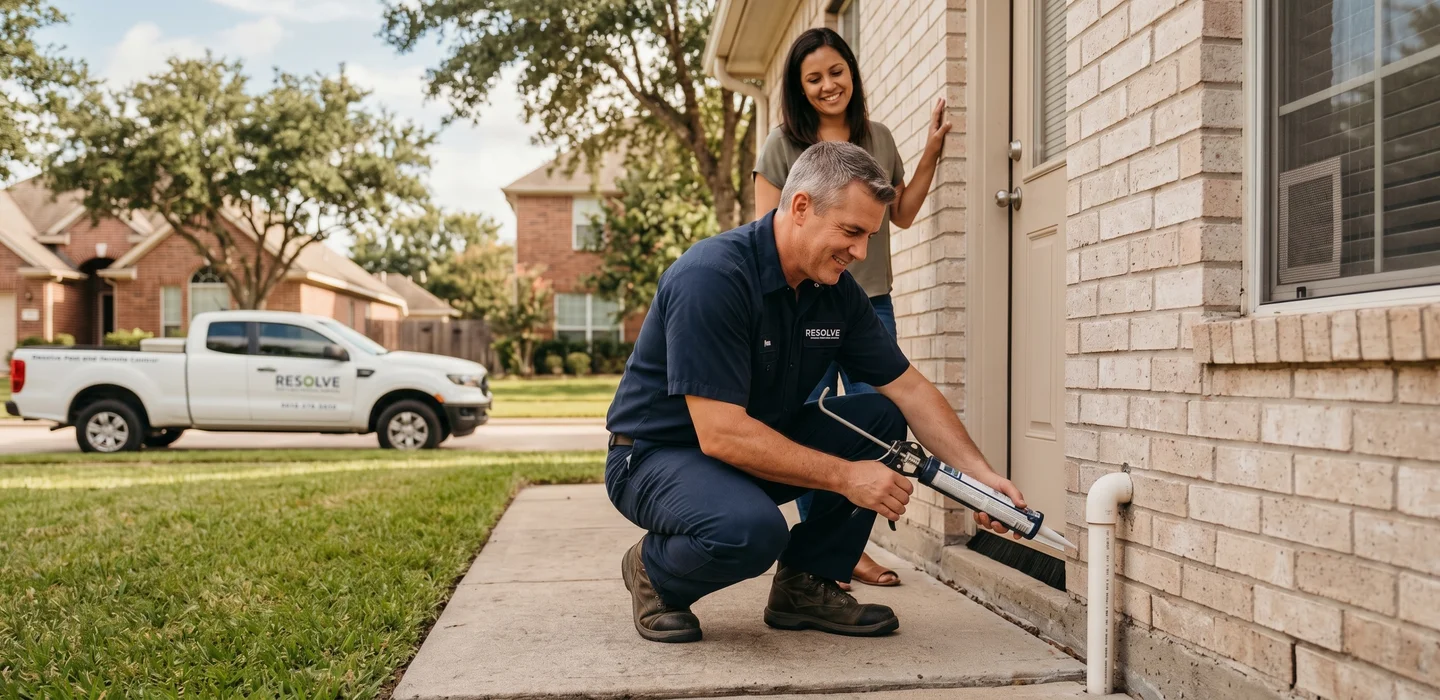
“Three years after Harvey we found mud tubes at the back of the garage. Our home was built in 2015 and we assumed we were protected. David explained that Harvey displaced colonies into areas that had never had them before, including our subdivision. He applied Termidor at the full perimeter and confirmed the colony was gone at the 90-day check. That conversation about Harvey changed how I think about pest prevention.”
Katy Subterranean Termite Treatment
Subterranean Termite Treatment in Katy, TX
Subterranean termites are by far the most common termite species in Katy. They live in the soil, forage to wood structures through mud tubes, and thrive in the moist conditions created by Katy's drip irrigation systems and post-Harvey soil disruption. Resolve provides targeted subterranean termite treatment using Termidor SC liquid barriers and Sentricon bait systems — matched to Katy's slab homes and the specific conditions at each property.
- Termidor SC barrier applied continuously at the foundation perimeter for active subterranean infestations in Katy
- Sentricon bait system for Katy homes where irrigation landscaping limits soil injection access
- Post-Harvey colony displacement assessment for Katy homes near the Addicks and Barker flood zones
- 90-day follow-up inspection included — confirms the colony is no longer active before treatment is closed out
Why Katy Homeowners Choose Resolve for Subterranean Termite Treatment
The right barrier or bait system for Katy's soil conditions — applied by the owner, not a rotating technician.
- David understands how Katy's sandy-loam soil and post-Harvey disturbance affect where subterranean colonies establish and forage
- Termidor SC is the industry's leading subterranean termiticide — fast colony impact through transfer behavior among foraging workers
- Sentricon bait provides long-term colony elimination without excavation — preferred when Katy irrigation landscaping blocks full perimeter injection
- Irrigation review included — identifies drip emitter placement contributing to persistent foundation moisture and elevated termite risk
- 90-day follow-up inspection included with every treatment — David does not close out a job until effectiveness is confirmed
- No mandatory bond or contract — annual inspection available without auto-renewal terms
Katy Homeowners on Resolve's Subterranean Termite Treatment
Termidor certified Post-Harvey expertise 90-day follow-up
“We had Sentricon installed because our front foundation is surrounded by a very dense landscape bed with a drip system underneath — no real way to inject liquid without ripping it all up. David placed the stations correctly, explained how the bait works, and checked uptake at the 90-day visit. Two stations showed bait taken. Six months later the mud tube activity near the garage is completely gone.”
“David treated our home for subterranean termites after finding active foraging near the back irrigation trench. What stood out was that he pointed out the irrigation issue first — the drip emitters were running right at the slab. He adjusted his treatment placement to account for the moisture zone. Most thorough termite tech I've ever dealt with.”
Subterranean Termite Treatment Services Resolve Provides in Katy
Barrier, bait, and moisture control — all three pillars of effective subterranean termite management in Katy.
Termidor SC Foundation Barrier
Continuous liquid barrier applied in the soil at the slab foundation perimeter. Termidor's transfer effect means termites that contact the treated zone carry product back to the colony, eliminating workers and reproductive population. The gold standard for active subterranean infestations in Katy slab homes.
Sentricon Bait System
In-ground bait stations placed at calibrated intervals around the perimeter intercept foraging subterranean termites. Bait is taken back to the colony and shared, eliminating the population from within. No soil injection required — ideal for Katy homes where irrigation systems and dense landscaping cover the foundation perimeter.
Post-Harvey Colony Displacement Assessment
For Katy homes within proximity to the Addicks and Barker flood zones, David performs a targeted assessment for colony displacement patterns — looking for activity in areas of the property that would not historically have been at risk before Harvey altered the local soil and colony distribution.
Irrigation and Moisture Control Review
Drip irrigation running along the foundation perimeter creates the persistent soil moisture that subterranean termites require for foraging. David identifies problematic emitter placement and advises on redirecting irrigation away from the slab edge as a structural complement to chemical treatment.
Garage and Expansion Joint Treatment
Garage slab expansion joints are a primary entry point for subterranean termites in Katy's slab construction. David applies Termidor directly at joint lines and any visible gaps at the slab-to-foundation transition for complete coverage.
Annual Inspection Plan
Annual inspection of barrier effectiveness or Sentricon bait uptake — without mandatory contracts. Katy's post-Harvey soil conditions and year-round warm temperatures make annual inspection a meaningful safeguard for treated properties.
How Resolve Treats Subterranean Termites in Katy
Full inspection, targeted treatment, 90-day confirmation.
- 1
Full Subterranean Termite Inspection
David inspects the full foundation perimeter, garage interior, expansion joints, and irrigation layout for mud tube evidence, soil disturbance, and moisture conditions. Species identification — subterranean versus drywood — is confirmed before any treatment decision is made.
- 2
Treatment Method Selected Based on Findings
Termidor liquid barrier for active infestations with accessible perimeter soil. Sentricon bait for properties where irrigation landscaping limits injection access or where long-term monitoring is the priority. David explains both options and the reasoning before any work begins.
- 3
Precision Application
Termidor applied via trench-and-treat at the foundation perimeter, factoring in irrigation moisture zones and the post-Harvey soil disturbance history for the specific Katy neighborhood. Sentricon stations placed at calibrated intervals and at high-activity foraging zones.
- 4
90-Day Follow-Up Inspection
David returns at 90 days to check for new mud tube activity, assess Sentricon bait uptake, and provide written documentation. If activity is still present, the satisfaction guarantee covers a return service visit at no additional charge.
Resolve Subterranean Treatment vs Bond-Centric Services in Katy
| Feature | Resolve Pest and Termite | Bond-Centric Companies |
|---|---|---|
| 90-day follow-up inspection included | ✓ | ✗ |
| No mandatory annual bond or contract | ✓ | ✗ |
| Post-Harvey soil disturbance context provided | ✓ | ✗ |
| Irrigation review included with treatment | ✓ | ✗ |
| Owner performs every inspection and treatment | ✓ | ✗ |
| Treatment options explained before commitment | Full explanation before any work begins | Often presented as package with no alternatives |
| Satisfaction guarantee | ✓ | Covered by bond terms — may require renewal to maintain |
Case Study
Cinco Ranch Home: Subterranean Colony Eliminated After Irrigation System Contributed to Repeated Treatment Failures
The Problem
A Cinco Ranch homeowner had treated for subterranean termites twice in three years with two different national companies. Both treatments used liquid barriers at the foundation perimeter, but the termites returned within 18 months each time. Mud tubes kept appearing at the same location along the back left foundation corner where a zone of drip irrigation emitters had run at full output for eight years.
Our Solution
David inspected the back left foundation corner in detail and identified that the irrigation zone had created a consistently saturated soil band at the slab edge that was washing out liquid termiticide within months of each treatment. He applied Termidor SC with trench-and-treat at the active zone and then installed four Sentricon bait stations at the back perimeter as a secondary interception layer. He also documented the irrigation zone as a persistent moisture risk and provided a written recommendation to the homeowner's landscaper.
The Outcome
The homeowner had the irrigation zone reconfigured to direct emitters away from the slab. The 90-day follow-up found Sentricon bait uptake at two stations and no new mud tube activity. At the 12-month annual inspection, the Sentricon stations still showed no new uptake and the foundation perimeter remained clear — the longest period without termite activity in three years.
Subterranean Termite Treatment FAQs for Katy Homeowners
How do subterranean termites get into Katy slab homes?
Subterranean termites enter slab homes through expansion joints between the garage floor and foundation, cracks in the slab, plumbing and utility penetrations, and any gap between the slab and the mudsill framing at the perimeter. They build mud tubes from the soil to these entry points, which are often concealed under mulch, concrete patios, or irrigation equipment.
Why do subterranean termites keep coming back after treatment in Katy?
Repeated reinfestation usually indicates that either the liquid barrier was not applied continuously — leaving gaps at landscaped perimeter sections — or that irrigation is washing out the termiticide faster than expected. Both are common issues in Katy's large-lot homes with extensive drip irrigation. A post-treatment irrigation review and a combination treatment using both barrier and bait significantly reduces reinfestation risk.
How long does subterranean termite treatment take for a Katy home?
A typical Termidor barrier treatment for a standard Katy slab home perimeter takes 2-4 hours depending on perimeter length, landscape density, and the number of active zones requiring trench-and-treat application. Sentricon station installation takes 1-2 hours. Residents do not need to vacate for either treatment.
Do Katy homes near the Addicks or Barker Reservoirs have higher termite risk?
Yes. The catastrophic flooding from Harvey caused sustained soil saturation and disturbance across the drainage areas near both reservoirs. Subterranean termite colonies were displaced and relocated in large numbers. Properties in west Katy and areas that experienced Harvey flooding have documented elevated subterranean termite activity in the years since the storm.
Is annual inspection necessary after subterranean termite treatment in Katy?
Annual inspection is strongly recommended given Katy's year-round warm temperatures, ongoing irrigation moisture at foundation edges, and the post-Harvey colony disruption that continues to affect the area. Even effective Termidor barriers benefit from annual checks to confirm no gaps have developed. Sentricon systems require annual bait inspection and refresh to remain active.
Get Subterranean Termite Treatment in Katy — Schedule Today
David inspects before treating and follows up at 90 days to confirm the colony is gone. Post-Harvey termite pressure in Katy is real — get a licensed assessment from a technician who understands west Harris County.