“We discovered mud tubes in our garage within two years of moving into our Bridgeland home. David explained that the soil under our landscaping bed hadn't been treated at construction and the colony was using an irrigation trench as its entry path. He treated the perimeter and the penetration point and the follow-up was completely clean. Should have called sooner.”
Subterranean Termite Treatment — Cypress, TX
Subterranean Termite Treatment in Cypress, TX
Subterranean termites in Cypress live in Harris County's clay soil — and they were there before the first master-planned community was built. Former agricultural land throughout Bridgeland, Stone Gate, and Blackhorse Ranch harbored established colonies for decades before development. Disturbing that soil during construction doesn't eliminate those colonies — it redirects them toward the nearest slab. Resolve provides licensed subterranean termite treatment that stops active foraging and protects Cypress foundations long-term.
- Full-perimeter liquid termiticide barrier for active subterranean and Formosan colony elimination
- Sentricon Always Active bait stations for ongoing colony interception near HOA retention ponds
- Treatment of under-slab plumbing penetrations — a primary entry point in Cypress new construction
Why Cypress Homeowners Trust Resolve for Subterranean Termite Treatment
Local expertise in Harris County clay-soil termite conditions with treatment methods matched to Cypress's specific development history.
- David treats every Cypress property personally — 20+ years of subterranean termite experience in Harris County clay soil
- Expert assessment of soil conditions unique to former agricultural land — the foundation of Cypress's termite risk
- Liquid barrier targets active colonies immediately — no waiting periods before colony elimination begins
- Sentricon bait stations intercept new foraging from HOA retention pond and detention basin moisture zones
- Plumbing penetration treatment included — the most common entry point in Cypress new construction
- No long-term contracts — annual monitoring is available but always optional
Cypress Homeowners on Resolve's Subterranean Termite Results
Clay Soil Expertise Plumbing Penetration Treatment HOA Pond-Adjacent Properties
“Our property backs to an HOA detention pond. David came out and immediately identified that the sustained moisture from the pond edge was supporting active foraging along our rear foundation. He applied a perimeter barrier and installed Sentricon stations along the back fence — the stations were showing interception within 30 days. That's exactly the right tool for that situation.”
“We saw swarmers in our living room in May and David fit us in within two days. He found subterranean activity along the front slab — not Formosan, just a well-established colony that had been in the soil since the land was farmland. The treatment was straightforward and David was clear about what the annual monitoring plan would and wouldn't cover. No overselling.”
Our Subterranean Termite Treatment Services in Cypress
Complete colony elimination and long-term prevention for Harris County's most common termite threat.
Full-Perimeter Liquid Barrier
Continuous Termidor or equivalent termiticide applied along the full foundation perimeter via soil trench-and-treat or rod injection. Kills active subterranean and Formosan colonies and creates a treated zone that prevents new foraging access to the slab.
Sentricon Always Active Monitoring
In-ground bait stations placed at perimeter intervals intercept foraging workers and eliminate the colony from the source. Especially effective for Cypress properties near HOA retention ponds and detention basins that provide sustained moisture for subterranean colony activity.
Under-Slab Plumbing Penetration Treatment
Plumbing penetrations through the slab are the most common subterranean termite entry point in Cypress new construction. Targeted soil injection at each penetration site closes the gap left by incomplete soil pre-treatment at rough-in.
Landscape and Irrigation Trench Assessment
Irrigation system trenches installed after construction often cut through the original soil pre-treatment zone, creating new subterranean access pathways to the foundation. David maps these trench lines and treats accordingly.
Formosan Colony Treatment
Formosan termites — a subterranean species that swarms near Cypress Creek corridors from April through June — are treated with the same liquid barrier and Sentricon methods as native subterranean species, but the larger colony size typically requires thorough perimeter coverage.
Annual Re-Inspection
A 12-month follow-up inspection verifies treatment effectiveness and checks for new colony activity. Given Cypress's ongoing construction and clay-soil conditions, annual monitoring is the most reliable way to stay ahead of future foraging pressure.
How Subterranean Termite Treatment Works in Cypress
From soil assessment through long-term monitoring — a clear process built for Harris County conditions.
- 1
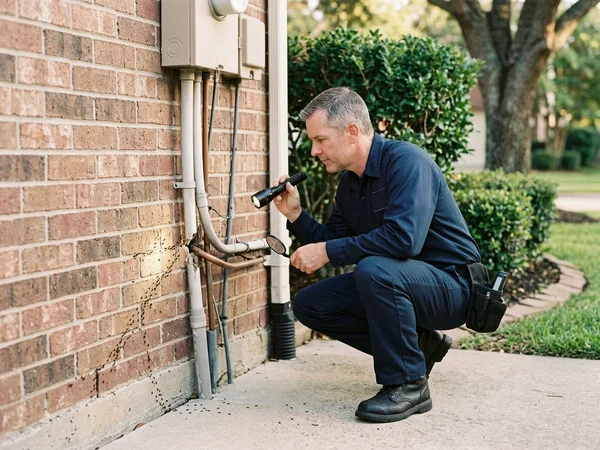
David inspects the foundation perimeter, garage slab, plumbing access areas, and exterior landscaping. For Cypress homes, he maps the irrigation system layout, mulch bed extent, and any post-construction landscaping that may have disrupted the original soil pre-treatment zone.
- 2
David recommends a liquid barrier, Sentricon stations, or both — based on colony activity, property layout, and proximity to sustained moisture sources like HOA retention ponds. He explains why each method is appropriate for your specific Cypress property before treatment begins.
- 3
Liquid termiticide is applied via soil trench-and-treat or rod injection along the full foundation perimeter. Plumbing penetrations and irrigation trench crossing points are treated as identified during inspection. Sentricon stations are installed at appropriate intervals.
- 4
A 45-day follow-up inspection confirms the liquid barrier is working and Sentricon stations show appropriate activity. Annual monitoring re-inspection keeps your Cypress foundation protected through future swarm seasons and any neighboring construction activity.
Resolve vs. DIY Termite Products for Subterranean Termites in Cypress
| Feature | Resolve Professional Treatment | DIY Termite Products |
|---|---|---|
| Professional-grade termiticide at effective soil concentrations | ✓ | ✗ |
| Full foundation perimeter coverage including penetrations | ✓ | ✗ |
| Formosan colony identification and treatment | ✓ | ✗ |
| Irrigation trench entry point assessment | ✓ | ✗ |
| Written treatment documentation for real estate and lenders | ✓ | ✗ |
| Lower upfront cost for materials | ✗ | ✓ |
| Annual monitoring with professional re-inspection | ✓ | ✗ |
Case Study
Cypress: Formosan Colony Traced to Irrigation Trench Entry Through Pre-Treatment Gap
The Problem
A Cypress homeowner in a newer Blackhorse Ranch subdivision reported finding mud tubes along the interior rear wall of their home's master closet — three years after construction. The home had received a soil pre-treatment at rough-in as required, but a post-construction irrigation system had been installed 18 months after move-in. The trenching for the irrigation system had cut directly through the treated soil zone along the rear foundation, creating a Formosan termite access pathway.
Our Solution
David traced the foraging pathway from the master closet wall back to the irrigation trench crossing point at the rear foundation. The pre-treatment gap was clearly visible in the soil profile. He applied targeted soil injection at the trench crossing, then completed a full-perimeter liquid barrier to address any additional vulnerabilities. Four Sentricon stations were installed at the rear corners and mid-points of the rear fence line.
The Outcome
The 45-day follow-up found no new foraging activity at the master closet wall or anywhere along the treated perimeter. Sentricon stations at the rear fence showed bait uptake, indicating the Formosan colony foraging pressure was still active from the soil beyond the fence — but being intercepted before reaching the structure. The homeowner enrolled in annual monitoring and was advised to inform their irrigation contractor about the soil pre-treatment consideration for any future trench work.
Subterranean Termite Treatment FAQs for Cypress, TX
Why is subterranean termite pressure so high in Cypress specifically?
Cypress is built primarily on former agricultural land with decades-old subterranean termite colonies established in Harris County's heavy clay soil. Clay retains moisture at depth, creating ideal termite foraging conditions year-round. When development graded and excavated this land, those colonies were displaced — often directly toward the new slab construction replacing their original habitat.
How do HOA retention ponds affect subterranean termite activity in Cypress?
Retention ponds and detention basins throughout Cypress's master-planned communities create sustained high-moisture soil zones near the pond edges. Subterranean termites forage toward moisture — making properties that back to or adjoin these HOA water features among the highest-risk in any Cypress community.
My Cypress home is only five years old — can I really have subterranean termites?
Yes. New construction on former agricultural land does not eliminate the soil colonies that were there before building. Soil pre-treatment at rough-in is required but coverage gaps are common, particularly at plumbing penetrations and perimeter landscaping areas added after move-in. Five-year-old Cypress homes are among the most common properties we treat.
What is the difference between Formosan and native subterranean termites in Cypress?
Both are subterranean species that live in the soil and forage into structures via mud tubes. Formosan termites form much larger colonies — sometimes several million workers — and cause more structural damage more quickly. They swarm seasonally from April through June near Cypress Creek. Both species are treated with the same liquid barrier and Sentricon methods.
How long does the liquid barrier treatment last in Harris County clay soil?
Under normal conditions, a properly applied liquid barrier in clay soil remains effective for 5 to 10 years. Clay soil's low permeability actually helps retain the treatment zone compared to sandy soils. However, landscaping changes, irrigation work, and construction activity can create new gaps over time — which is why annual monitoring is recommended.
Related Termite and Pest Services in Cypress
Stop Subterranean Termites in Cypress Before They Reach Your Structure
Harris County's clay soil and Cypress's former agricultural land create subterranean termite pressure that doesn't go away on its own. Liquid barriers and Sentricon monitoring — applied by David personally — stop active colonies and protect your Cypress foundation long-term. No contracts, no surprises.